

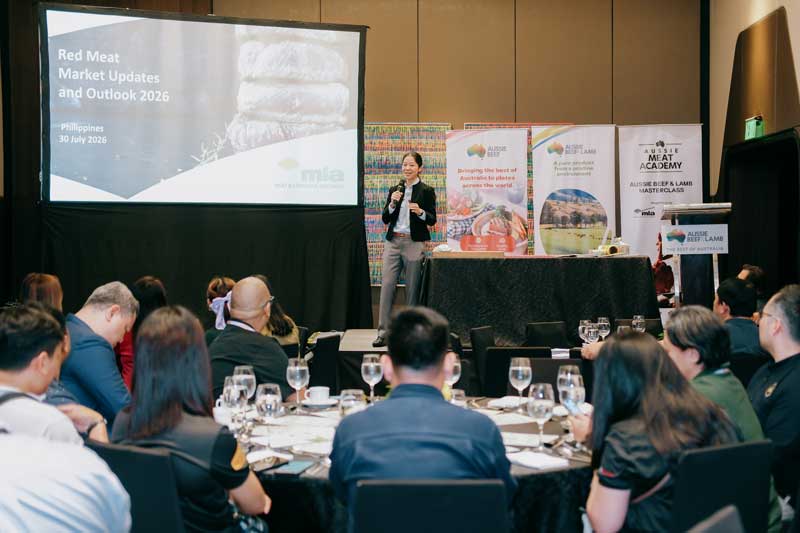
澳大利亚肉类与畜牧业协会东南亚区域经理瓦莱斯卡在菲律宾的行业交流活动中,介绍红肉市场最新情况。
从马尼拉热闹的展会现场,到曼谷开展市场推广活动,再到越南持续攀升的市场需求,澳大利亚肉类与畜牧业协会(MLA)东南亚区域经理瓦莱斯卡表示,该地区仍可为澳大利亚牛羊肉出口商带来重大机遇。
在最新一期《实地见闻》播客节目中,瓦莱斯卡从菲律宾连线分享近况。MLA 在当地为行业参与世界食品博览会(WOFEX)提供支持,该展会是菲律宾规模最大的食品贸易展会之一。
聚焦马尼拉
尽管澳大利亚未在世界食品博览会上直接设展,但澳大利亚肉类与畜牧业协会(MLA)通过贸易研讨会及客户交流活动保持了较高曝光度。
“研讨会到场约50人,本次展会规模盛大。我每次到访都能看到参展商的整体水准与档次在不断提升。” 瓦莱斯卡表示。
该展会主要面向本土企业,约90%的参展商来自菲律宾。不过国际参展力量正在壮大,全球主要竞争对手都在积极开拓这一市场。
“欧洲、巴西、美国以及加拿大的企业均有到场,” 她说道,“菲律宾是我们重点发力的市场之一,我们致力于提升澳大利亚产品在当地的地位,不局限于加工用牛肉品类。”
澳大利亚出口商通过企业展位以及进口商陈列专区完成亮相,也体现出该市场对澳大利亚高端产品愈发重要。
蕴藏两类差异化机遇的市场
菲律宾历来是加工用牛肉的重要市场,这类牛肉主要供应汉堡连锁、香肠生产以及当地规模庞大的腌牛肉产业。
“我对菲律宾的腌牛肉有了很多了解。” 瓦莱斯卡打趣道。
不过她认为,随着消费偏好发生变化,第二波市场机遇正在显现。
“消费者对高品质产品的认可度不断提升。谷饲、草饲牛肉,安格斯和和牛越来越多地进入酒店以及高级餐厅。”
这一趋势并非只出现在马尼拉。伴随着零售业态的整体现代化,高端产品的需求正逐步向菲律宾全国扩散。
“大型零售企业陆续入局市场,这将会彻底改变行业格局。有望重构市场,为澳大利亚高端产品创造新机遇。” 瓦莱斯卡表示。
马尼拉依旧是主要的进口目的地,宿务也逐步发展成为重要的加工与分销枢纽。完善冷链配套仍是重点工作,对于冷鲜牛肉而言尤为关键。
为把握该增长机遇,澳大利亚肉类与畜牧业协会(MLA)加大当地市场投入,派驻业务开发代表常驻当地,提升客户对澳大利亚红肉的认知。
东南亚吸引全球目光
随着全球贸易格局持续转变,东南亚已然成为国际供应商愈发重要的角逐之地。
近期市场动态显示,部分澳大利亚牛肉货源从中国转向东南亚市场。与此同时,南美及其他地区的出口商也在该区域积极挖掘新机遇。
瓦莱斯卡表示,市场竞争正在不断加剧。
“南美企业十分活跃,攻势强劲。昨天展会上,我们和巴西屠宰加工企业进行交流,对方表示正在寻找替代出口市场。”
如今几乎东南亚每一场贸易展会都能见到巴西出口商的身影,阿根廷近期取得印尼市场准入资格,同样在谋求业务扩张。
但瓦莱斯卡认为,澳大利亚长期在东南亚布局投入,为本国行业保持竞争优势奠定良好基础。
“我们不会安于现有成绩。澳大利亚牛肉正在加大在东南亚的市场动作,我认为这既是守住高端细分市场的契机,也可以通过其他渠道持续拉动需求增长。”
澳大利亚肉类与畜牧业协会(MLA)数年前便决定在泰国、越南、菲律宾等市场组建本土团队,这些团队是澳大利亚出口商可借助的优质区域资源。
健康养生与蛋白质消费兴起
东南亚一个备受关注的新兴趋势,是消费者对健康养生的关注度不断提升。
澳大利亚肉类与畜牧业协会(MLA)近期在泰国开展一项全新市场推广活动,名为 “澳洲肉食助力奔跑”,融合健身运动、零售合作以及消费者试吃体验。
“现在马拉松、Hyrox 综合体能赛以及各类健身活动广受大众欢迎。” 瓦莱斯卡说道。
该项目与泰国大型零售集团麦德龙(Makro)合作打造,旨在将澳大利亚牛肉与崇尚活力生活方式的消费群体建立关联。
参与者完成跑步项目后,可以品尝澳大利亚牛肉试吃产品,以此建立蛋白质摄入与健康生活的直接联系。
“健康养生的消费趋势不会消退。我们研究如何复用这套活动模式,争取在东南亚其他地区落地推广。” 瓦莱斯卡表示。
本次推广活动也与 MLA 东盟足球合作项目形成互补,该项目为澳大利亚牛肉搭建渠道,对接多个市场的体育爱好者群体。
泰国市场的增长机遇
泰国依旧是该地区最具发展潜力的市场之一。
瓦莱斯卡表示,收入提升、年轻消费群体崛起以及饮食习惯转变,共同推动牛肉需求上涨。
“我们实际上才刚刚起步。” 她说道。
泰国不少年轻消费者开始接受牛肉,而老一辈对这类蛋白食材的消费较少。与此同时,泰国进口牛肉规模整体仍然不大,存在可观的增长空间。
目前澳大利亚在泰国进口牛肉市场占据主导地位,能够充分把握消费者对安全优质高端产品日益增长的需求红利。
“可以看到,餐饮门店以及零售终端都十分愿意引入澳大利亚牛羊肉。” 瓦莱斯卡称。
越南市场持续蓄势发展
越南同样属于重点市场,受益于强劲的经济增长、旅游业复苏,以及当地本就偏好肉类消费的饮食文化。
“越南饮食文化向来十分看重肉类食材。” 瓦莱斯卡表示。
民众日益富裕,带动高品质蛋白食材的需求上涨,酒店餐饮行业的投入也为澳大利亚出口商带来更多机遇。
澳大利亚肉类与畜牧业协会(MLA)近期与一家扩张规划宏大的涮涮锅及烧肉连锁餐饮达成合作,也体现出市场对消费需求增长的信心不断提升。
“活牛与包装牛肉两大品类均存在增长机会。” 她说道。
尽管今年贸易环境时有起伏,但行业反馈显示市场动能正在重新积聚。
市场教育仍是核心工作
展望未来,瓦莱斯卡表示市场教育仍将是澳大利亚肉类与畜牧业协会(MLA)东南亚战略的重要支撑。
“澳洲肉类学院” 项目依旧是市场开拓的核心支柱,用于培训客户、普及产品知识并巩固行业合作关系。
除各类市场教育项目之外,MLA 还依托东盟足球合作项目,在东南亚各地体育场开展球迷互动活动。
从马尼拉的行业展会,到东盟多国体育场的市场推广活动,再到泰国与越南的高端品类增长机遇,东南亚持续证明其已然成为澳大利亚红肉出口商最重要的增长区域之一。伴随竞争日趋白热化,MLA 的本土驻点布局以及在该地区的长期投入,正显现出前所未有的价值。
消息来源:MLA
Southeast Asia opportunities grow as competition intensifies
MLA Regional Manager for Southeast Asia Valeska presents a red meat market update during industry engagement activities in the Philippines.
From bustling trade show floors in Manila to running activations in Bangkok and growing demand in Vietnam, MLA's Regional Manager for Southeast Asia, Valeska, says the region continues to offer significant opportunities for Australian beef and lamb exporters.
On the latestOn the Groundpodcast episode, Valeska checked in from the Philippines, where MLA was supporting industry engagement at the World Food Expo (WOFEX), one of the country's largest food trade events.
Manila in focus
While Australia did not exhibit directly at WOFEX, MLA maintained a strong presence through trade seminars and customer engagement activities.
"We had about 50 people at the seminar and the show was huge. Each time I've been back, you can see the quality and calibre of the exhibitors improving" Valeska commented.
The event primarily attracts local businesses, with around 90 per cent of exhibitors coming from the Philippines. However, the international presence is growing, with major global competitors actively targeting the market.
"The Europeans, Brazilians, US and Canada are all there," she said. "The Philippines is one of those markets where we're really trying to strengthen Australia's position beyond manufacturing beef."
Australian exporters were represented through both company exhibits and importer displays, highlighting the growing importance of the market for premium Australian products.
A market with two distinct opportunities
The Philippines has traditionally been a strong market for manufacturing beef, supplying products used in burger chains, sausage production and the country's sizeable corned beef sector.
"I've learned a lot about corned beef in the Philippines," Valeska joked.
However, she believes a second wave of opportunity is emerging as consumer preferences evolve.
"We are seeing a higher appreciation for quality products. Grainfed and grassfed beef, Angus and Wagyu are increasingly finding their place in hotels and fine dining restaurants."
The trend is not limited to Manila. Demand for premium products is gradually spreading throughout the country alongside broader retail modernisation.
"We're seeing larger retail players entering the market and that's going to be a game changer. It could help disrupt the market and create new opportunities for premium Australian products" Valeska said.
While Manila remains the primary import destination, Cebu is also developing as an important manufacturing and distribution hub. Improving cold chain capability remains a key focus area, particularly for chilled beef.
To support this growth, MLA has increased investment in-market, including placing a business development representative on the ground to increase customer knowledge around Australian red meat.
Southeast Asia attracts global attention
As global trade patterns continue to shift, Southeast Asia has become an increasingly important battleground for international suppliers.
Recent market movements have seen Australian beef volumes redirecting from China into Southeast Asia. At the same time, exporters from South America and elsewhere are actively pursuing new opportunities across the region.
Valeska said competition is intensifying.
"The South Americans are really active and quite aggressive. At the show yesterday we spoke with Brazilian packers who indicated they're looking at alternative markets."
Brazilian exporters are now appearing at virtually every trade event across the region, while Argentina has recently gained access to Indonesia and is also pursuing expansion opportunities.
However, Valeska believes Australia's long-term investment in Southeast Asia positions the industry well to maintain its competitive edge.
"We're not resting on our laurels. Australian beef is definitely ramping up activities across Southeast Asia, and I think it's an opportunity to really secure the premium segment while continuing to grow demand through other channels."
MLA made a decision several years ago to invest in local teams across markets such as Thailand, Vietnam and the Philippines, who are a great regional resource for Australian exporters to leverage.
Health, wellness and the rise of protein
One emerging trend attracting significant attention across Southeast Asia is the growing consumer focus on health and wellness.
MLA recently tested a new activation in Thailand called the ‘Aussie Meat You Run’, combining fitness, retail partnerships and consumer sampling.
"We're seeing everyone getting into marathons, Hyrox events and other fitness activities," Valeska said.
The initiative was developed in partnership with Makro, one of Thailand's largest retail groups, and aimed to connect Australian beef with active lifestyle consumers.
Participants completed the run before enjoying Australian beef samples, creating a direct link between protein consumption and healthy living.
"The health and wellness trend isn't going away. We're looking at how we can use this template and potentially roll it out across the region” Valeska said.
The activation also complements MLA's broader ASEAN football partnership, which provides opportunities to connect Australian beef with sports fans across multiple markets.
Thailand's growth story
Thailand remains one of the region's most exciting opportunities.
According to Valeska, rising incomes, younger consumers and changing eating habits are all contributing to growing beef demand.
"We're really only at the beginning," she said.
Many younger Thai consumers are embracing beef despite previous generations consuming less of the protein. At the same time, imported beef volumes remain relatively modest, creating significant room for growth.
Australia currently dominates Thailand's imported beef sector and is well positioned to benefit from increasing consumer demand for premium, safe and high-quality products.
"We are seeing real interest in putting Australian beef and lamb on restaurant menus and retail shelves," Valeska said.
Vietnam continues to build momentum
Vietnam remains another priority market, supported by strong economic growth, tourism recovery and a deep-rooted food culture that embraces meat consumption.
"The food culture in Vietnam has always had a strong focus on meat," Valeska said.
Growing affluence is driving demand for higher-quality protein options, while investment across the hospitality sector is creating additional opportunities for Australian exporters.
MLA recently partnered with a major shabu shabu and yakiniku restaurant chain with ambitious expansion plans, highlighting growing confidence in consumer demand.
"We see growth opportunities across both live cattle and boxed beef," she said.
While trading conditions have been mixed at times this year, feedback from industry suggests momentum is building again.
Education remains central
Looking ahead, Valeska said education will continue to underpin MLA's Southeast Asian strategy.
The Aussie Meat Academy program remains a core pillar of market development, helping train customers, build product knowledge and strengthen industry relationships.
Alongside education initiatives, MLA is also leveraging its ASEAN football partnership through fan engagement activities in stadiums across the region.
From trade shows in Manila to stadium activations across ASEAN and premium growth opportunities in Thailand and Vietnam, Southeast Asia continues to demonstrate why it's become one of the most important growth regions for Australian red meat exporters. As competition heats up, MLA's on-the-ground presence and long-term investment in the region are proving more valuable than ever.
Source:MLA

