

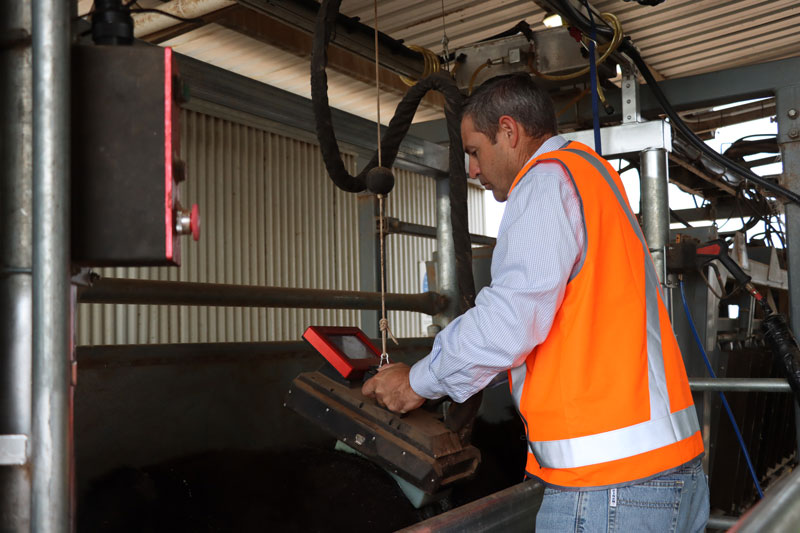
凯文・詹金森在普莱姆城协助对饲养中期的和牛开展扫描检测。
位于新南威尔士州利顿市的JBS里维纳育肥场,许可存栏规模46000头,在保定栏中多花短短几分钟检测时间,有望提升供应链下游环节的运转效率。
据JBS育肥场持续改进经理凯文・詹金森介绍,这一预期改善得益于一款全新客观检测工具。该工具由澳大利亚肉类与畜牧业协会(MLA)出资立项,联合MEQ Solutions公司开展试验。
这款手持设备名为MEQ Live,能够依据客观大理石花纹评分,在育肥场内对牛只实现更精准的分群。
该检测数据让JBS在制定饲喂方案时更有把握、操作更灵活,目标是产出批次性状更加均一的牛群,同时保障屠宰环节胴体分选具备实际可操作性。
消除个体差异
MEQ Live设备已应用于里维纳育肥场的短周期、中周期安格斯牛入栏流程,扫描检测完全兼容场内现有的安全商业牲畜操作规范。
扫描可以为工作人员提供牛只当下大理石花纹状况的客观实时结果,结果划分为由JBS设定的三个等级区间。
“过去,我们对入栏牛只进行分群,主要依据体重,再结合从业经验判断牛只的体格构成。”凯文说道。
“但即便经过这套分选流程,同一饲喂方案下的牛只,最终大理石花纹表现依旧差异很大。”
这种个体差异会在一体化产业链中产生连锁影响,这也意味着育肥场可以制定更有针对性的饲喂方案,让直至屠宰加工端的产品品质更加稳定。
MEQ Live已经在里维纳育肥场投入使用18个月。试验第一阶段主要开展数据采集与效果验证。
“现在进入第二阶段,我们研究如何利用这些数据指导经营决策,评估预期的效率提升能否实现商业化落地。”凯文介绍。
“由于牛只在运抵屠宰厂之前,就按照相近的大理石花纹评分区间完成分群,屠宰流水线上的胴体个体差异得以减少。”
凯文特别说明,MEQ Live并非预测工具。
“我们扫描牛只,并不是预判它最终出栏时的大理石花纹等级。”他表示。
“它只是对牛只检测当日状态的客观测量。
“这些实时检测评分用于牛只入栏时评级,并据此分群。将一部分分选工作转移到上游育肥环节,缓解屠宰加工端的工作压力。”
引入第二台扫描设备
今年3月26日,JBS在新南威尔士州格里菲斯附近的普莱姆城育肥场新增第二台 MEQ Live 扫描设备,该育肥场许可存栏规模34000头,设备开始用于和牛的扫描检测。
不过和里维纳育肥场在安格斯牛入栏时扫描的做法不同,普莱姆城育肥场是在和牛饲喂周期的中段开展扫描。
该场和牛的饲喂周期通常约400天,凯文表示检测时机十分关键。
“对于长周期饲喂的牛只,稍晚阶段扫描,对高价值和牛的检测准确度会更高。” 他说道。
“但如果扫描时间距离屠宰过近,会打乱牛群的社群等级秩序,改变牛只短期行为,进而影响肉质。
“选择饲喂中期扫描,既可以在大理石花纹差异充分显现后获取客观检测数据,又能把对牛只的干扰降到最低。”
和里维纳育肥场一样,MEQ Live并不用于预判牛只最终出栏指标。
饲喂中期扫描得到的是当下的大理石花纹评分,据此可以对牛只分级,在后续饲喂周期实施更有针对性的饲养管理。
普莱姆城育肥场的首次现场扫描得到MEQ Solutions的现场支持,该公司负责设备安装与员工培训,澳大利亚肉类与畜牧业协会(MLA)也到场观察这项技术在商业化场景下的实际表现。
凯文称,JBS十分看重可以提升全供应链生产效率的技术迭代。
“我们一直在寻找更优的作业方式,兼顾牛只福利、员工工作以及客户需求。” 他表示。
“只要某项工具能够提升产业链任一环节的生产效率与盈利水平,就值得去探索尝试。”
消息来源:MLA
New measurement tech cuts the guesswork from feedlot sorting
Kevin Jenkinson helping scan mid-program Wagyu cattle at Prime City.
At JBS’s 46,000 head licence capacity Riverina Feedlot in Leeton, NSW, a few extra minutes in the crush is anticipated to improve efficiency at the other end of the supply chain.
According to JBS Feedlot Continuous Improvement Manager Kevin Jenkinson, the anticipated improvement is linked to a new objective measurement tool being trialled through an MLA-funded project with MEQ Solutions.
Known as MEQ Live, the handheld device is enabling cattle to be grouped more accurately in the feedlot based on objective marbling score.
This information is giving JBS greater confidence and flexibility when making feeding decisions, with the aim of delivering more consistent lines of cattle and supporting operationally viable carcase sorting at processing.
Removing variation
MEQ Live has been built into Riverina’s induction for their short and mid-fed Angus cattle programs, with scanning fitting within their existing safe animal commercial handling practices.
The scan provides staff with an objective snapshot of the animals’ marbling status at that point in time – which fits into one of three ranges determined by JBS.
“In the past, we were sorting cattle that came in based on weight and what learned experience told us about physical composition,” Kevin said.
“But that sorting process still left a lot of variation in marbling outcomes in each feeding program.”
That variation has flow-on effects across the integrated system, highlighting the opportunity for more targeted feeding decisions in the feedlot and greater consistency through to processing.
MEQ Live has been operating at Riverina for 18 months. The first phase of the trial focused on data collection and validation.
“Now in phase two, we’re examining the outcomes of using that data to inform business decisions, and to assess whether the expected efficiencies can be realised on a commercially viable basis,” Kevin said.
“Because animals are grouped into similar marble score ranges well before they arrive at the plant, there is less variability between carcases on the chain.”
Kevin is quick to point out that MEQ Live is not a prediction tool.
“We’re not scanning cattle to say what marble score they’ll finish on,” he said.
“It’s an objective measurement of where an animal is at on the day.
“Those point-in-time scores are used to rank cattle at induction and draft them into groups accordingly, shifting some of the sorting task upstream and easing pressure at processing.”
Second scanner introduced
On 26 March this year, JBS introduced a second MEQ Live scanner at their 34,000-head licence capacity Prime City Feedlot near Griffith, NSW, beginning scans on Wagyu cattle.
However, unlike the Angus cattle scanned at induction at Riverina, JBS is scanning the Prime City Wagyu midway through the feeding program.
With their Wagyu typically fed for about 400 days, Kevin said timing was critical.
“For a longer feeding program, scanning later provides a greater accuracy in high-value Wagyu,” he said.
“But leaving it too close to slaughter can disrupt social hierarchy, which can change animals’ short-term behaviour and in turn can affect meat quality.
“Scanning at the midpoint allows us to gather objective marbling differences to be captured once they are clearer, while minimising disruption to cattle.”
As with Riverina, MEQ Live is not being used to predict final outcomes.
Instead, the mid-program scan provides a point-in-time marbling score that allows cattle to be ranked and managed more deliberately through the remainder of the feeding program.
The first Prime City scan was supported on site by MEQ Solutions, who assisted with installation and staff training, with MLA also involved in observing the technology’s performance in a commercial setting.
Kevin said JBS values the ongoing development of technology that can lift productivity across the supply chain.
“We’re always looking for ways to do things better – for the cattle, our staff and our customers,” he said.
“If a tool strengthens productivity and profitability anywhere in the system, it’s worth exploring.”
Source:MLA

