

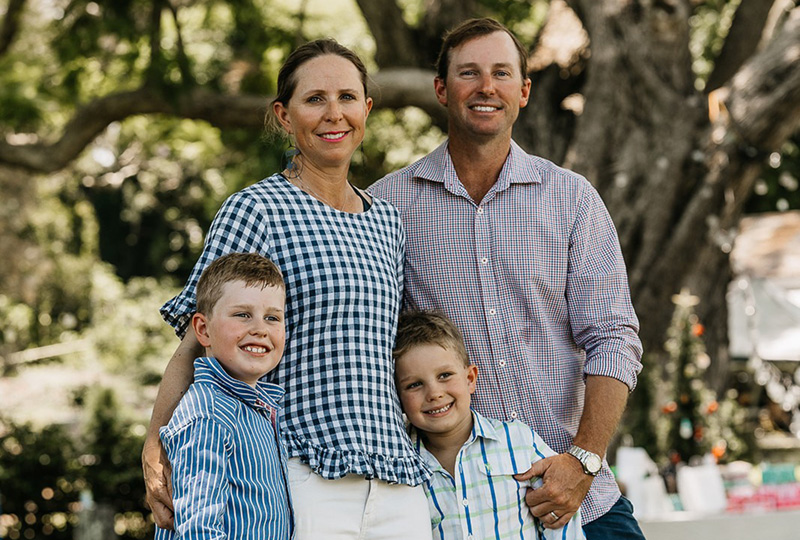
萨莎・特雷洛尔与威尔・特雷洛尔,以及他们的两个儿子坎贝尔(左)和赞德(右)。
在昆士兰州西部红穆尔加地貌的起伏坡地上,第四代牧场经营者威尔・特雷洛尔与萨莎・特雷洛尔,过去十年来一直在打造抗涝又耐旱、韧性更强的放牧草场。
夫妻俩的有机肉牛牧场占地72979公顷,坐落于查尔维尔以西的库拉迪附近,由二人自主经营管理。
牧场由威尔的父母交到他们手中。威尔2012年回到牧场,萨莎2013年前来与他一同经营。威尔表示,他们一直致力于改善草场生态功能,在这片土地上,每一次降雨都弥足珍贵。
近期,夫妇二人加入拉克伦・休斯基金会(LHF)项目,该项目每年选拔十名学员,旨在提升学员以下方面能力:
土地管理
能力建设
个人发展
草场与项目规划设计
再生农业
威尔表示,参与该项目让他们实现了个人与业务层面的双重成长,使他们更有信心把握新机遇,持续探索改善草场生态的各类途径。
休牧、轮牧,大胆实践探索
在2023年加入拉克伦·休斯基金会项目之前,威尔和萨莎就已经开启牧场改良之路,目标是更高效地利用每年的降雨。
“过去我们反复观察到,每次降雨过后,牧场内90%的雨水都会直接流失,这严重制约了草场在干旱时期维持自身运转的能力。”威尔说道。
“2013年之后,我们又接连遭遇数年干旱。为数不多的降水快速流失,这促使我们想方设法把更多水分留存到牧场生态系统之中。”
除了水资源流失,夫妇二人也注意到土壤肥力同样存在损耗。作为行动的第一步,他们前往罗克汉普顿参加了RCS盈利放牧课程。
“课程结束后,为优化草场放牧管理方案,我们逐步缩小围栏地块面积,增加牛只饮水点。”威尔介绍。
“随后我们推行轮牧与地块休牧制度,以此优化牧草供给与牧草利用效率。
“目前我们拥有约40个放牧地块,目标是每块地至少休牧两个月,依靠实地植被状态来判定轮牧时机。”
萨莎表示,这套轮牧模式除了提升地表植被覆盖率、减缓雨水径流、提高牧场载畜量之外,也促使他们更加深入地研究牧草组成、土壤健康以及整体草场生态功能之间的关联。
随着地块休牧时间拉长,夫妇二人发现草场的植物物种多样性有所提升。他们开始思考,这些植物能够反映出牧场怎样的生态状况。
“我们不再把非优选牧草或者杂草当成需要立刻清除的麻烦,而是先去探究它们为何会在此处生长。”萨莎说。
“这种植物向我们传递了哪些土壤健康的信号?它是否在为草场下一阶段的生态演替创造条件?”
“我很喜欢《意念的力量》书中的一句话:‘当你看待事物的角度发生改变,你眼中的事物也会随之改变。’
“这句话重塑了我们处理问题的思路,让我们跳出部分传统模式,尝试新方案,始终将草场的长期生态健康放在首位。”
土地再生,重拾探索思维
各类专题研讨会带来的启发,加上与行业专家交流所收获的知识,让威尔备受鼓舞。2022年,经其他牧场经营者推荐,他报名参加由塔温公园培训机构开设、斯图尔特·安德鲁斯授课的自然序列农业课程。
正是在这次课程上,他结识菲利普·休斯与阿黛尔·休斯夫妇,二人是已故的拉克伦的父母,拉克伦·休斯基金会(LHF)正是为纪念他而设立。
威尔与萨莎于2023年正式参与该基金会项目。2024年,二人成功获得拉克伦·休斯年度奖学金,得以对接再生农业领域专业人士,接受培训与导师指导。
通过多场专题研讨、特邀嘉宾分享以及一对一辅导,项目学员可以接触到广泛的知识板块,涵盖经营管理、领导力、沟通技巧以及再生农业。
对威尔和萨莎而言,土壤健康、微生物学以及植物演替相关课程,是价值最高的学习内容之一。
“大量学习内容帮助我们更好理解地表之下正在发生的变化。”萨莎说道。
“课程重点讲解土壤健康、微生物,以及不同植物物种对整体草场生态功能起到的作用。
“这些内容进一步坚定了我们的认知:草场修复是长期过程,人为管理措施应当顺应自然体系,而不是强行追求快速改造。
“这片土地的现状并非一朝一夕形成,它的修复也不可能一蹴而就。”她表示。
“理解生态演替,清楚各类植物承担的功能,让我们在草场管理上变得更有耐心,也更善于观察。”
个人成长
除技术知识之外,夫妻俩表示该项目带来的部分最大改变体现在个人层面。
“项目十分注重个人成长与能力提升,重点培养学员跳出舒适区的自信心。”威尔说道。
“落实到牧场经营上,就是敢于尝试新思路,相信自己做出的管理决策。
“我们此前已经开始做出改变,但这个项目让我们更加确信:可以换一种角度思考问题,持续学习,如果确信新方案能够改善草场生态,就可以大胆尝试。”
面对未来不可避免的干旱周期,这份信心也给了他们底气,让他们更加信赖自己搭建的整套管理体系,这套体系可以提升地表植被覆盖率、促进雨水下渗,增强草场抗灾韧性。
牧场之外,萨莎表示最明显的变化就是威尔愿意走出舒适区,对外分享自家牧场的实践故事,例如在今年北方肉牛研究进展大会的澳大利亚肉类与畜牧业协会牛肉行业早餐会上进行分享。
“这些公开分享的机会,让我们得以结识更多牧场经营者,借鉴他人实践经验。”萨莎说道。
“经常会有其他养殖户过来交流,聊他们牧场遇到的难题,探讨这些管理思路能否适配他们的土地。
“这也让我们明白,不存在放之四海而皆准的解决方案,但从业者之间可以互相学习借鉴。
“我想我们俩都认同,参与这个项目最大的收获就是:既要保持好奇心,也要拥有信心,相信自己,相信土地,也相信我们整个行业。”
消息来源:MLA
Building drought resilience through smarter grazing management
Sasha and Will Treloar with their sons Campbell (left) and Zander (right).
On the sloping terrains of western Queensland’s Red Mulga country, fourth-generation producers Will and Sasha Treloar have spent the past decade building a more resilient grazing landscape capable of withstanding both flood and drought.
Based near Cooladdi, west of Charleville, the couple own and operate their 72,979ha organic beef enterprise.
They took over the reins from Will’s parents. Since his return to the property in 2012, with Sasha joining him in 2013, Will said they have focused on improving landscape functions, particularly in an environment where every rainfall event needs to count.
More recently, the pair became involved in the Lachlan Hughes Foundation (LHF) – a program offered to ten participants annually to build capabilities in:
land management
capacity building
personal development
landscape and project design
regenerative agriculture.
Will said it was a move which has helped them grow both personally and professionally, giving them greater confidence to pursue new opportunities and continue exploring ways to improve their landscape.
Resting, rotation and really giving it a crack
Prior to their participation in LHF in 2023, Will and Sasha started their journey with the goal of better utilising annual rainfall events.
“We were repeatedly watching what we now know was 90% of our water run off the property after every rainfall event – which was really limiting our grazing country’s ability to sustain itself through dry periods,” Will said.
“2013 also marked the beginning of several years of drought for us, so seeing what little rain we did receive leave the landscape so quickly really motivated us to look for ways to keep more of that water in the system.”
Alongside lost water, the pair noted that there was likely also a loss of soil fertility. They made the call to attend an RCS Grazing for Profit course in Rockhampton as their first step to action.
“To improve our grazing land management strategy following the course, we slowly began reducing our paddock sizes and increasing water point access for cattle,” Will said.
“We then introduced a rotational grazing and paddock rest system to optimise our pasture availability and utilisation.
“We now have around 40 paddocks that we aim to rest for a minimum of two months – relying on visual cues to determine when we rotate.”
In addition to increasing ground cover, slowing water runoff and improving carrying capacity, Sasha said the rotational grazing strategy encouraged them to take a closer look at the relationship between pasture composition, soil health and overall landscape function.
As paddocks were afforded longer rest periods, the couple began noticing greater diversity in the species returning to the landscape. They questioned what those plants revealed about the condition of their country.
“Rather than seeing non-preferred species or weeds as a problem that needed to be immediately dealt with, we became more interested in understanding why they were there first,” Sasha said.
“What was that plant telling us about the health of our soils? Was it playing a role in preparing the landscape for the next stage of succession?”
“There’s a quote I love from the book The Power of Intention which reads, ‘if you change the way you look at things, the things you look at change.’
“It's probably reframed the way we respond to things and allowed us to step outside some of our traditional approaches and try new ideas, with the long-term health of the landscape always front of mind.”
Regenerating land and reviving curiosity
Invigorated by the insights gained through attending workshops and connecting industry experts, Will jumped at the chance to attend Tarwyn Park Training’s Natural Sequence Farming course with Stuart Andrews in 2022, when it was recommended by a fellow producer.
This is where he met Philip and Adele Hughes – parents of the late Lachlan, who founded LHF in his memory.
Will and Sasha began their involvement in the foundation in 2023. In 2024, they were successful recipients of the Lachlan Hughes annual scholarship, which linked them with regenerative agriculture professionals for training and mentoring.
Through a series of workshops, guest speakers and mentoring sessions, the program exposed participants to a broad range of topics spanning business management, leadership, communication and regenerative agriculture.
For Will and Sasha, one of the most valuable learning opportunities came through sessions focused on soil health, microbiology and plant succession.
“A lot of the learning helped us better understand what was happening below the surface,” Sasha said.
“There was a big focus on soil health, microbes and understanding how different plant species contribute to the broader function of the landscape.
“The sessions reinforced our growing belief that landscape recovery is a long-term process and that management interventions should work with natural systems rather than attempt to force rapid change.
“The country didn't get like this overnight and it won't return to what it was overnight either,” she said.
“Understanding succession and the role different plants play has helped us become more patient and more observant in how we manage the landscape.”
Personal growth
Beyond the technical learnings, the couple said some of the program's greatest impacts were personal.
“There was a lot of focus on personal growth and development – particularly in terms of building the confidence to step outside of your comfort zone,” Will said.
“On-farm, that translated to having the confidence to trial new ideas and trust the decisions we were making.
“We’d already started changing things, but the program reinforced that it was okay to think differently, keep learning and be open to trying new approaches if we thought they could improve our landscape.”
That confidence has also provided reassurance as the couple look towards the next inevitable dry period, giving them greater faith in the systems they have put in place to improve groundcover, water infiltration and landscape resilience.
Off-farm, Sasha said one of the most noticeable changes was Will's willingness to step outside his comfort zone and share their story with others, such as at the MLA beef industry breakfast as part of this year’s Northern Beef Research Update Conference.
“Those public speaking events alone have created so many more opportunities to connect with other producers and learn from their experiences,” Sasha said.
“Quite often people will come up and start conversations about the challenges they're facing on their own properties and how some of these ideas might work in their landscape.
“It reinforces that there’s no one-size-fits-all solution, but there’s a lot we can learn from each other.
“I think we can both agree that the key take home from this project is the need to be both curious and confident in not just yourself, but in your land, and in our industry.”
Source:MLA

