

核心要点
供给收紧推动羔羊与绵羊各项主要指标创下冬季价格纪录。
2026年冬季维多利亚州、南澳大利亚州绵羊上市量跌至历史低位。
大部分绵羊主产区产羔季开局向好。
2026年澳大利亚绵羊与羔羊市场经历了波动起伏的冬季。
澳大利亚南部大部分地区普降降雨,部分区域更是结束持续干旱,历经多年饲草、水源短缺之后,养殖户有信心启动羊群补栏重建工作。市场乐观情绪回升,带动后备补栏羊只需求旺盛。
肉类蛋白供给收缩,加工企业对羔羊与成年绵羊的采购需求保持强劲。补栏养殖户与加工厂在交易市场激烈竞争有限的羊源。
采购商瞄准同类羊只货源,传统采购模式界限日渐模糊,推动羔羊和成年绵羊价格创下历史新高。2026年冬季多项绵羊、羔羊市场指标刷新纪录,具体总结如下:
商品羔羊指标——2026年7月12日当周,1244美分/公斤胴体重
轻量羔羊指标——2026年7月12日当周,1184美分/公斤胴体重
成年绵羊指标——2026年7月12日当周,916美分/公斤胴体重
美利奴羔羊指标——2026年7月12日当周,1152美分/公斤胴体重
后备补栏羔羊指标——2026年6月28日当周,1235美分/公斤胴体重
线上羔羊指标——2026年7月7日当周,253澳元/只
尽管各项指标现已从历史高点有所回落,但肉类蛋白供给处于历史低位,依旧对需求形成支撑。
虽然2026年产羔数量预期大幅改善,但羊群重建仍需时间。
各州上市量明细
(1)新南威尔士州
6‑8月新南威尔士州羔羊上市量共计827600只,较去年冬季下降29%,较五年均值低31%。绵羊上市量为270278只,同比下滑 45%。
(2)维多利亚州
维多利亚州冬季上市量跌幅位居前列。羔羊上市量共计239073只,较2025年下降37%,较五年均值低36%。绵羊上市量同比下降37%,至77762只,创下该州拍卖行自2000年有记录以来绵羊上市量最低值。
(3)南澳大利亚州
南澳州冬季供给再度大幅下降。羔羊上市量共计55479只,同比下降44%,较五年均值低42%,为历史第二低冬季羔羊上市水平。历史最低出现在2022年,当年羔羊上市量仅40373只。绵羊上市量降幅更大,同比下跌51%,仅有11894只,创下该州冬季绵羊上市量历史新低。
(4)塔斯马尼亚州
拍卖行羔羊上市量同比下降45%,至10045只;绵羊上市量为4920只,同比大幅下滑70%。
(5)西澳大利亚州
羔羊上市量同比回落32%,为145224只,但仍较五年均值高出15%。绵羊上市量共计48732只,同比下降46%,仅较五年均值低8%。
(6)昆士兰州
昆士兰州冬季上市量有所下滑,羔羊上市量4885只,同比下降18%。绵羊上市量跌幅更大,下降39%,至3597只。
展望后市
春季短期市场展望显示供给仍将维持偏紧态势。
尽管绵羊与羔羊各项指标已从冬季历史高点回落,但肉类蛋白供给偏低仍持续支撑市场需求。
澳大利亚多数绵羊主产区气候条件好转,市场对 2026 年产羔季表现向好抱有期待。近几周拍卖行新季羔羊上市数量可观,进一步印证这一乐观预期。
除西澳西南部、维多利亚州东部、塔斯马尼亚部分降雨偏少区域外,全国羊群从现有基数恢复仍需时日,供给难以快速大幅增长。
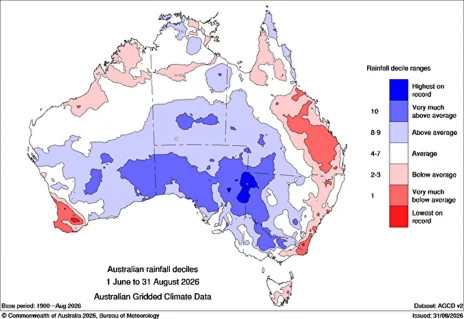
2026年6‑8月澳大利亚降雨量。数据来源:澳大利亚气象局
信息来源:澳大利亚肉类及畜牧业协会(MLA)市场信息分析师 亚历克斯·弗莱
本信息发布于2026年9月4日,发布时内容准确无误。
澳大利亚肉类及畜牧业协会(MLA)不对本刊物所载任何信息的准确性、完整性及时效性作出任何保证。用户使用或依赖本刊物任何内容,风险自行承担;因使用或依赖相关信息所造成的任何损失与损害,MLA概不承担任何责任。未经MLA事先书面许可,本刊物任何内容不得擅自转载、复制。凡使用MLA刊物、报告及相关信息,均须遵守MLA市场报告及信息使用条款。
消息来源:MLA
Record winter for sheep and lamb markets as tight supply drives prices
Key points
Tight supply drove record winter lamb and sheep prices across key indicators.
2026 winter sheep yardings in Victoria and SA penned record lows.
A positive start to the lambing season across most sheep regions.
Australia’s sheep and lamb market experienced an eventful winter in 2026.
Widespread, and in some cases drought-breaking, rainfall across much of southern Australia gave producers the confidence to begin rebuilding flocks after years of feed and water scarcity. The renewed optimism drove strong restocker demand.
Lower meat protein supply supported strong processor demand for both lamb and mutton. The result led both restockers and processors to compete strongly for available stock in the saleyard.
Traditional buying patterns became increasingly blurred as buyers targeted similar categories of sheep and drove lamb and mutton prices to record highs. Several sheep and lamb market indicators reached record levels during winter 2026, as summarised below:
Trade Lamb Indicator – 1,244¢/kg carcase weight (cwt) on the week ending 12 July 2026
Light Lamb Indicator – 1,184¢/kg cwt on the week ending 12 July 2026
Mutton Indicator – 916¢/kg cwt on the week ending 12 July 2026
Merino Lamb Indicator – 1,152¢/kg cwt on the week ending 12 July 2026
Restocker Lamb Indicator – 1,235¢/kg cwt on the week ending 28 June 2026
Online Lamb Indicator – $253/head on the week ending 7 July 2026.
While indicators have since eased from their record highs, the historically lower meat protein supply continues to support demand.
Despite much improved expectations for lambing numbers in 2026, a flock rebuild will take time.
State-by-state yarding breakdown
(1)NSW
NSW lamb yardings totalled 827,600 head between June and August, down 29% from last winter and 31% below the five-year average. Sheep yardings reached 270,278 head, a decline of 45% year-on-year.
(2)Victoria
Victoria recorded one of the sharpest declines in yardings over winter. Lamb yardings totalled 239,073 head, down 37% from 2025 and 36% below the five-year average. Sheep yardings fell 37% YoY to 77,762 head, marking the smallest sheep yarding at Victorian saleyards since records began in 2000.
(3)SA
SA recorded another significant decrease in supply over winter. Lamb yardings totalled 55,479 head, down 44% year-on-year and 42% below the five-year average, making it the second-lowest winter lamb yarding on record. The only lower result was recorded in 2022, when lamb yardings reached 40,373 head. Sheep yardings fell even further, declining 51% year-on-year to just 11,894 head, the smallest winter sheep yarding on record for the state.
(4)Tasmania
Lamb saleyard throughput fell 45% YoY to 10,045 head, while sheep yardings reached 4,920 head, a 70% drop YoY.
(5)WA
Lamb yardings eased 32% YoY to 145,224 head, but remained 15% above the five-year average. Sheep yardings totalled 48,732 head, down 46% year-on-year, although only 8% below the five-year average.
(6)Queensland
Queensland recorded lower yardings over winter with lamb yardings reaching 4,885 head, an 18% year-on-year decline. Sheep yardings fell more sharply, dropping 39% to 3,597 head.
Looking ahead
The immediate outlook for spring points to continued tight supply.
While sheep and lamb indicators have eased from the record highs experienced over winter months, decreased meat protein supply continues to underpin demand.
Seasonal conditions have improved across many of Australia's key sheep-producing regions, supporting optimism for a strong 2026 lambing season. This confidence has been reinforced by reports of solid numbers of new-season lambs appearing at saleyards in recent weeks.
Apart from some lower rainfall areas, including south-west WA, eastern Victoria and parts of Tasmania, rebuilding the national flock from current levels will take time limiting any rapid increase in supply.
Australian rainfall June-August 2026. Source: Bureau of Meteorology
Attribute content to Alex Fry, MLA Market Information Analyst.
Information is correct at time of publication on 4 September 2026.
MLA makes no representations as to the accuracy, completeness or currency of any information contained in this publication. Your use of, or reliance on, any content is entirely at your own risk and MLA accepts no liability for any losses or damages incurred by you as a result of that use or reliance. No part of this publication may be reproduced without the prior written consent of MLA. All use of MLA publications, reports and information is subject to MLA’s Market Report and Information Terms of Use.
Source:MLA

