

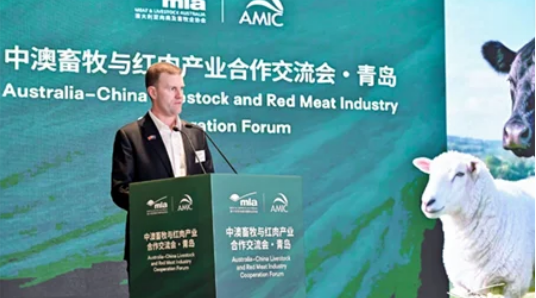
在澳中牛肉贸易面临保障措施关税不确定性之际,澳大利亚肉类与畜牧业协会(MLA)没有局限于短期市场难题,而是着力投入更长久的事业:搭建行业合作关系。
澳大利亚肉类与畜牧业协会大中华区经理默里·戴维斯在近期一期《实地见闻》播客节目中介绍,在贸易紧张局势备受关注的背景下,澳中红肉行业相关方开展的特色交流项目,正助力双方加深对彼此供应链的理解。
“在这种时期,增进相互理解、尊重与友好往来,有益无害。”默里表示。
今年早些时候,中国对进口澳大利亚牛肉启动保障措施,该交流项目由此发起。一旦澳大利亚牛肉进口量超出配额门槛,将征收55%的保障关税。
澳大利亚肉类与畜牧业协会并未仅仅着眼于贸易带来的影响,而是借此机会深化行业底层合作关系。
在澳中关系国家基金会的支持下,涵盖全供应链的中方代表受邀赴澳,实地深入考察当地生产体系。
代表团成员包含养殖户、育肥场经营者、加工企业人员、科研人员、政府官员及行业代表,先后参观澳大利亚牛羊牧场、育肥场、加工工厂与科研机构。
后续澳方回访活动中,澳大利亚肉牛协会、澳大利亚绵羊养殖户协会、澳大利亚育肥场协会、澳大利亚肉类加工企业协会、澳大利亚肉类行业协会以及澳大利亚肉类与畜牧业协会等机构负责人到访中国,实地了解中国畜牧产业。
澳方代表团走访北京、内蒙古以及国内主要产区,考察范围从小型乡村肉牛养殖模式,到大型加工企业与政府主管机构。
在默里看来,本次交流的价值十分显著。
“出口销售经理和进口端采购人员之间本就保持稳固联系,但除此之外,双方更深层次的行业联结较为薄弱。”他说道。
互访过程中,双方都看到彼此的优势。
中方代表团对澳大利亚的良种繁育、质量溯源体系、无疫病状态,以及依托充足本土饲料资源同时生产草饲、谷饲牛肉的能力印象深刻。
澳方参访人员也发现,快速发展的中国畜牧业有诸多值得学习之处。
中国虽然常被视作消费市场,但其在育种项目、自动化与加工技术方面同样实力突出。
“中国在加工环节的自动化和机器人应用方面水平很高。”默里称。
“我认为双方存在很大的合作潜力。”
关税重塑贸易格局
构建行业关系仍是长期重点。
行业当下面临的核心问题是保障措施关税,该关税对澳大利亚对华牛肉出口造成显著影响。
默里介绍,当前出口量较去年同期下降70%至80%。
冻牛肉贸易受到的冲击尤为明显,但冷鲜牛肉展现出更强的抗风险能力。
尽管价格上涨,开市客、山姆会员店等高端零售渠道仍持续上架澳大利亚冷鲜牛肉。
相关产品依旧在货架销售,保留澳大利亚原产地标识,吸引愿意支付溢价的消费者。
“我们并未从货架上消失,”默里表示。
“市场上确实有一批消费者认可澳大利亚牛肉产品。”
但在表象之下,市场仍处在高度不确定的环境中。
据悉,行业企业将大量货物存放于冷库与保税仓库,观望关税政策走向,为1月1日配额重新生效后可能到来的贸易增量做好准备。
默里认为,配额重置后,大批澳大利亚牛肉将立刻进入中国市场。
其中既包含目前仓储中的库存,也包含正在育肥、计划后续出口的肉牛。
“这是首次出现这类情况,我们没有过往经验可供参考。”
配额谈判仍存变数
另一项备受关注的动向是,澳大利亚有望获得其他出口国未用完的配额额度。
近期乌拉圭相关的磋商引发行业关注,但默里提醒,即便配额可以转让,可涉及的数量大概率有限。
美国、新西兰、阿根廷等多个国家尚有大量配额未使用,不过任何相关协议都需要参与国与中国主管部门共同认可。
“保障措施机制设立的初衷就是减少进口。”默里说道。
目前,相关谈判仍在闭门推进,行业各方暂时保持观望状态。
在中国市场展示澳大利亚牛肉
尽管面临市场阻力,澳大利亚肉类与畜牧业协会在中国的市场推广工作仍全速推进。
今年余下时间将重点开展两大活动。
首场是在上海举办的中国国际进口博览会,澳大利亚肉类与畜牧业协会联合澳出口企业,通过美食品鉴、切割演示以及直播活动展示澳大利亚红肉产品。
紧随其后,上海国际食品饮料及餐饮设备展览会将举办澳大利亚肉类与畜牧业协会年度上海屠夫挑战赛,集结12支屠夫团队参赛,彰显澳产肉类的多样烹饪特性与优良品质。
默里认为,持续开展市场活动也折射出对华贸易的普遍现状。
“在中国市场,一切都不会一成不变。”他表示。
政策更迭、贸易流量波动,市场不确定性持续存在,但有一点始终不变——维系双方行业紧密联系至关重要。
澳大利亚红肉行业正在中国市场经历又一段复杂时期,而这类行业纽带的价值,或许不亚于任何贸易协定。
消息来源:MLA
Why Australian beef remains on shelves in China
As Australia's beef trade with China navigates the uncertainty of safeguard tariffs, Meat & Livestock Australia (MLA) is looking beyond short-term market challenges and investing in something more enduring: relationships.
Speaking on a recent On the Ground podcast episode, MLA Greater China Regional Manager Murray Davis outlined how a unique exchange program between Australian and Chinese red meat stakeholders was helping build understanding across both supply chains at a time when trade tensions remained front of mind.
"At these times, increasing mutual understanding and respect and friendship does little harm," Murray said.
The initiative was sparked by China's decision to trigger safeguard measures on Australian beef imports earlier this year. The safeguard imposed a 55% tariff once Australia's quota threshold was exceeded.
Rather than focusing solely on the trade implications, MLA sought an opportunity to strengthen relationships deeper within the industry.
With support from the National Foundation for Australia – China Relations, Chinese representatives spanning the entire supply chain were brought to Australia for an intensive look at local production systems.
The delegation included producers, lot feeders, processors, researchers, government officials and industry representatives who toured Australian cattle and sheep enterprises, feedlots, processing facilities and research organisations.
A return visit saw leaders from organisations including Cattle Australia, Sheep Producers Australia, the Australian Lot Feeders' Association, AMPC, AMIC and MLA travel through China to gain firsthand insight into the country's livestock industry.
The Australian delegation's journey stretched from Beijing through inner Mongolia and into major production regions, exposing participants to everything from village-scale cattle production systems to large processing facilities and government agencies.
For Murray, the value of the exchange was clear.
"There were very, very strong relationships between export sales managers and procurement people on the import side, but beyond that the linkages were quite weak," he said.
The visits revealed strengths on both sides.
Chinese participants were impressed by Australia's genetics, integrity systems, disease-free status and ability to produce both grassfed and grainfed beef using abundant domestic feed resources.
Australian visitors discovered opportunities for learning within China's rapidly evolving livestock sector.
Despite often being viewed primarily as a market, China also demonstrated significant capability in breeding programs, automation and processing technology.
"They're very good on their automation and use of robots in processing," Murray said.
"I think there's definitely some potential for collaboration."
Tariffs reshape trade flows
Relationship-building remains a long-term priority.
The immediate issue facing the industry was safeguard tariffs, which impacts on Australian beef exports to China had been significant.
According to Murray, export volumes were currently running 70–80% below the same period last year.
Frozen beef trade had been particularly affected, although surprisingly, chilled beef had proven more resilient.
Premium retailers including Costco and Sam's Club continued to stock Australian chilled beef despite higher prices.
The products remained visible on shelves and carry Australian branding to attract consumers willing to pay a premium.
"We haven’t disappeared from the shelves," Murray said.
"There are people there that really do value that Australian product."
Behind the scenes, however, the market was dealing with considerable uncertainty.
Industry participants were reportedly holding large volumes of product in cold storage and bonded warehouses, waiting to see how tariff settings evolved and positioning for a potential influx of trade when quota arrangements reset on 1 January.
Murray believed substantial volumes of Australian beef could enter the Chinese market immediately after the reset.
This would include product currently held in storage, as well as cattle already on feed for future export programs.
"It's the first year this has happened and we've got no precedent really to go on," he said.
Quota negotiations remain uncertain
Another closely watched development is the possibility of Australia accessing unused quota allocations from other exporting nations.
Recent discussions involving Uruguay had attracted industry attention, although Murray cautioned that any potential transfer was likely to involve relatively modest volumes.
While several countries including the United States, New Zealand and Argentina have significant unused quotas available, any agreement would require support from both participating countries and Chinese authorities.
"The whole purpose of the safeguards mechanism was to reduce imports," Murray said.
For now, industry participants remain in a holding pattern as negotiations continue behind closed doors.
Showcasing Australian beef in China
Despite market headwinds, MLA's marketing activity in China continues at full pace.
Two major events will dominate the calendar throughout the remainder of the year.
The first is the China International Import Expo (CIIE) in Shanghai where MLA and Australian exporters will showcase Australian red meat through tasting events, cutting demonstrations and live-streaming activities.
Shortly afterwards, Food & Hotel China will host MLA's annual Shanghai Butchers Challenge, bringing together 12 teams of butchers to compete in an event designed to highlight the versatility and quality of Australian product.
For Murray, the ongoing engagement reflected a broader reality about doing business in China.
"Nothing is really ever business as usual in China," he said.
Amid changing policies, fluctuating trade flows and ongoing uncertainty, one thing remained constant – the importance of maintaining strong connections between industries on both sides of the relationship.
As Australia's red meat sector works through another complex chapter in the China market those connections may prove just as valuable as any trade agreement.
Source:MLA

