

核心要点
新南威尔士州北部干旱气候引发肉牛大规模抛售,众多养殖户选择出栏牲畜。
塔姆沃思与达博拍卖场本周肉牛上市量均创下新高。
新南威尔士州北部拍卖场为本州牲畜交易量贡献显著。
新南威尔士州北部部分地区干旱加剧,促使肉牛大量出栏,带动主要牲畜拍卖场上市量创下历史新高,也推高了2026年初全州的牲畜交易总量。
干旱致新州北部肉牛上市量创历史新高
复活节后,新南威尔士州北部肉牛抛售行情仍在延续,达博、塔姆沃思本周肉牛上市量分别创下11200头和7553头的单周纪录。斯康和冈尼达两地拍卖场的上市量同样表现强劲,形成有力支撑。
区域内干旱加剧,促使大量养殖户集中出栏牲畜。澳大利亚气象局数据显示,局部地区已出现降雨缺口(见下图)。
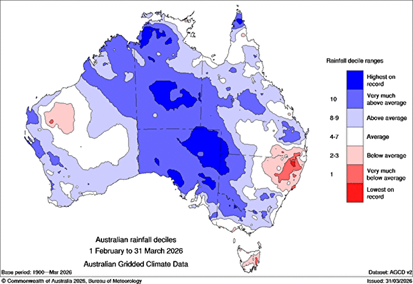
来源:澳大利亚气象局
以下为新南威尔士州北部主要牲畜拍卖场近期肉牛上市量汇总。
塔姆沃思
塔姆沃思近六场拍卖包揽了历史上市量前六纪录,本周上市量达7553头,再度刷新历史新高。
斯昆
斯昆本场上市量3466头,位列历史第二高位,仅比2006年4月11日的纪录少181头。
冈尼达
冈尼达历史上市量前六的记录均自 2026 年3月起产生,本周拍卖上市量达7200头,仅比3月17日创下的纪录少50头。冈尼达上市量走高的一个重要原因是,当地牲畜市场设施于2025年完成重大升级,这或助推了上市量提升。
阿米代尔
历史上市量前六的纪录中,有三项均出自2026年3月之后。最高纪录为2003年2月13日的4912头,其次是2026年3月26日的4219头。
因弗雷尔
因弗雷尔有纪录以来上市量前五均出现在2026年3月及以后,2026年3月17日创下4653头的历史最高上市量。
新南威尔士州中部牲畜上市量同样走高
虽然新州中部降雨偏少的情况不如北部明显,但局部地区降雨频次也有所减少。
达博自2026年初以来牲畜上市量居高不下,4月16日创下11200头的上市量纪录。除此纪录外,历史上市量排名其后的四场均出现在2025年11月至12月期间。
综合交易量评估
塔姆沃思、冈尼达、因弗雷尔、阿米代尔、斯昆、达博六地今年迄今累计牲畜交易量已达241007头。这是自2005年以来同期最高交易量,远超2018年的205208头与2015年的197487头,位列历史同期第二高。
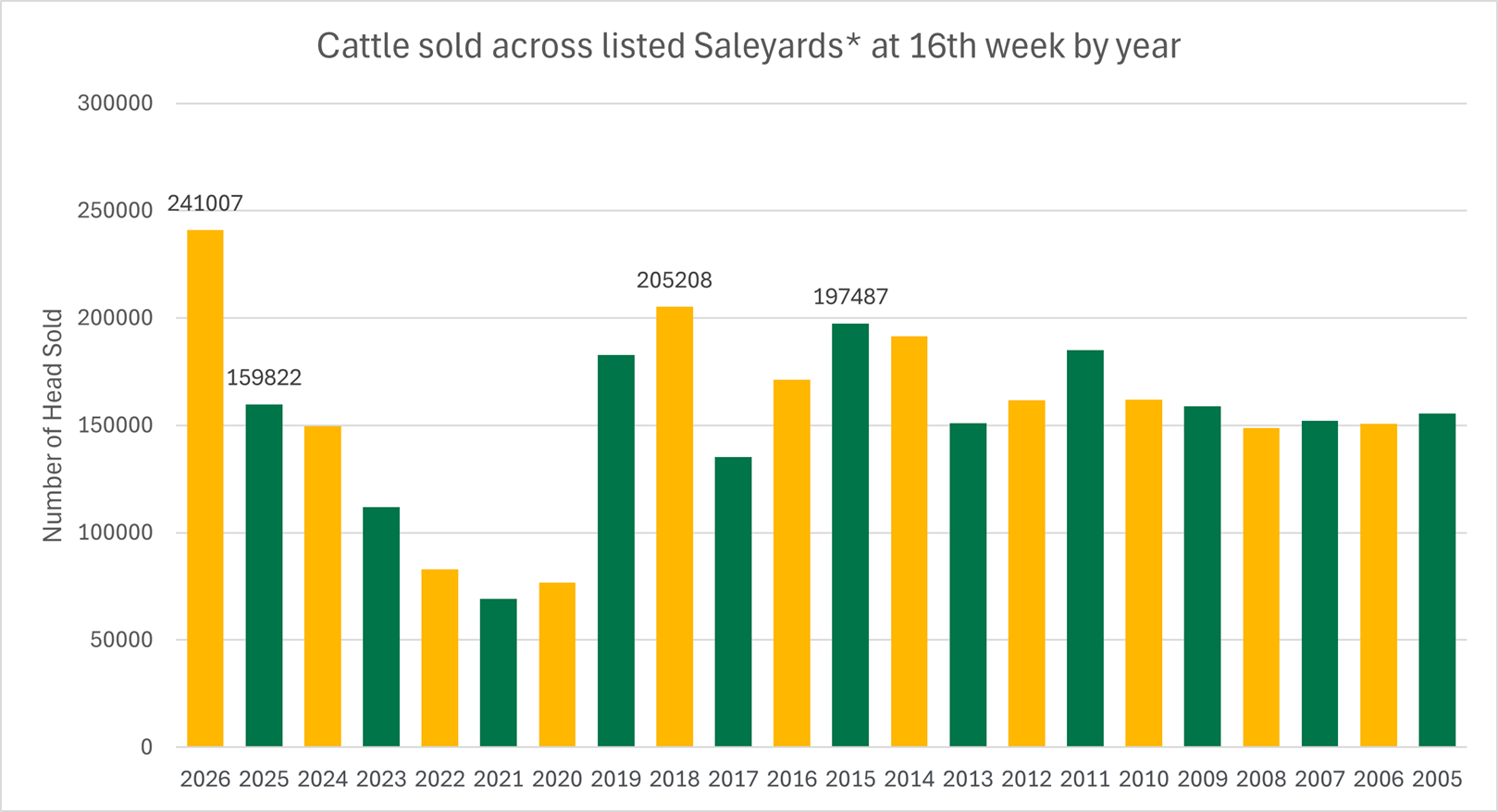
纳入统计的牲畜拍卖市场包括:塔姆沃思、冈尼达、因弗雷尔、阿米代尔、斯昆及达博。来源:国家牲畜报告服务中心(NLRS)
内容出处:MLA市场信息分析师 亚历克斯·弗莱。
本信息截至2026年4月16日撰稿时准确无误。
澳大利亚肉类及畜牧业协会不对本刊物所载信息的准确性、完整性及时效性作出任何保证。用户使用或依赖本刊物任何内容,风险自负,协会不对因此产生的任何损失或损害承担法律责任。未经协会事先书面许可,不得转载本刊物任何内容。凡使用本协会刊物、报告及相关信息,均须遵守协会市场报告与信息使用条款。
消息来源:MLA
Northern NSW producers drive record cattle yardings
Key points
Dry conditions across northern NSW are driving large-scale cattle sell-off, with many producers choosing to offload stock.
Tamworth and Dubbo saleyards both achieved record yardings this week.
Northern NSW saleyards contributed to significant state throughput.
Drying conditions across parts of northern NSW are driving heavy cattle turn‑off, pushing yardings at key saleyards to record levels and contributing to elevated state‑wide throughput early in 2026.
Record yardings in northern NSW due to dry conditions
The cattle sell-off across northern NSW has continued following the Easter break, with Dubbo and Tamworth achieving a weekly yarding record of 11,200 and 7,553 head respectively. This was supported by strong yardings at both Scone and Gunnedah.
Drying conditions across the region have prompted many producers to offload stock. Bureau of Meteorology (BoM) data indicates rainfall deficits are isolated (see figure below).
Source: BOM
Below is a summary of recent cattle yardings across key northern NSW saleyards.
Tamworth
The top six yardings recorded in Tamworth have all occurred across the last six sales, with this week’s yarding breaking the record at 7,553 head.
Scone
The yarding in Scone was 3,466 head – the second largest yarding on record and just 181 head shy of the record on 11 April 2006.
Gunnedah
The top six yardings recorded in Gunnedah are all from March 2026 onwards, with this week’s sale reaching 7,200 head (just 50 head below the record set on 17 March). One important factor to consider in Gunnedah’s case is the 2025 completion of major upgrades to the facility, which may have driven higher yardings.
Armidale
Three of the top six record yardings have occurred since March 2026. The record yarding occurred on 13 February 2003 at 4,912 head, followed by 4,219 head on 26 March 2026.
Inverell
The top five yardings on record at Inverell are all from March 2026 onwards, with a record yarding of 4,653 head on 17 March 2026.
Central NSW yardings also lift
While not as pronounced as the lower-than-average rainfall in northern NSW, parts of central NSW have also experienced fewer rain events.
Dubbo has had some significant yardings since the start of 2026 – with a record yarding of 11,200 head set on 16 April. Outside of this, the following four yardings all occurred in November and December in 2025.
Assessing the combined throughput
Combined year‑to‑date throughput across Tamworth, Gunnedah, Inverell, Armidale, Scone and Dubbo has reached 241,007 head. This is the highest volume recorded for the same period since 2005, exceeding the next highest totals recorded in 2018 (205,208 head) and 2015 (197,487 head).
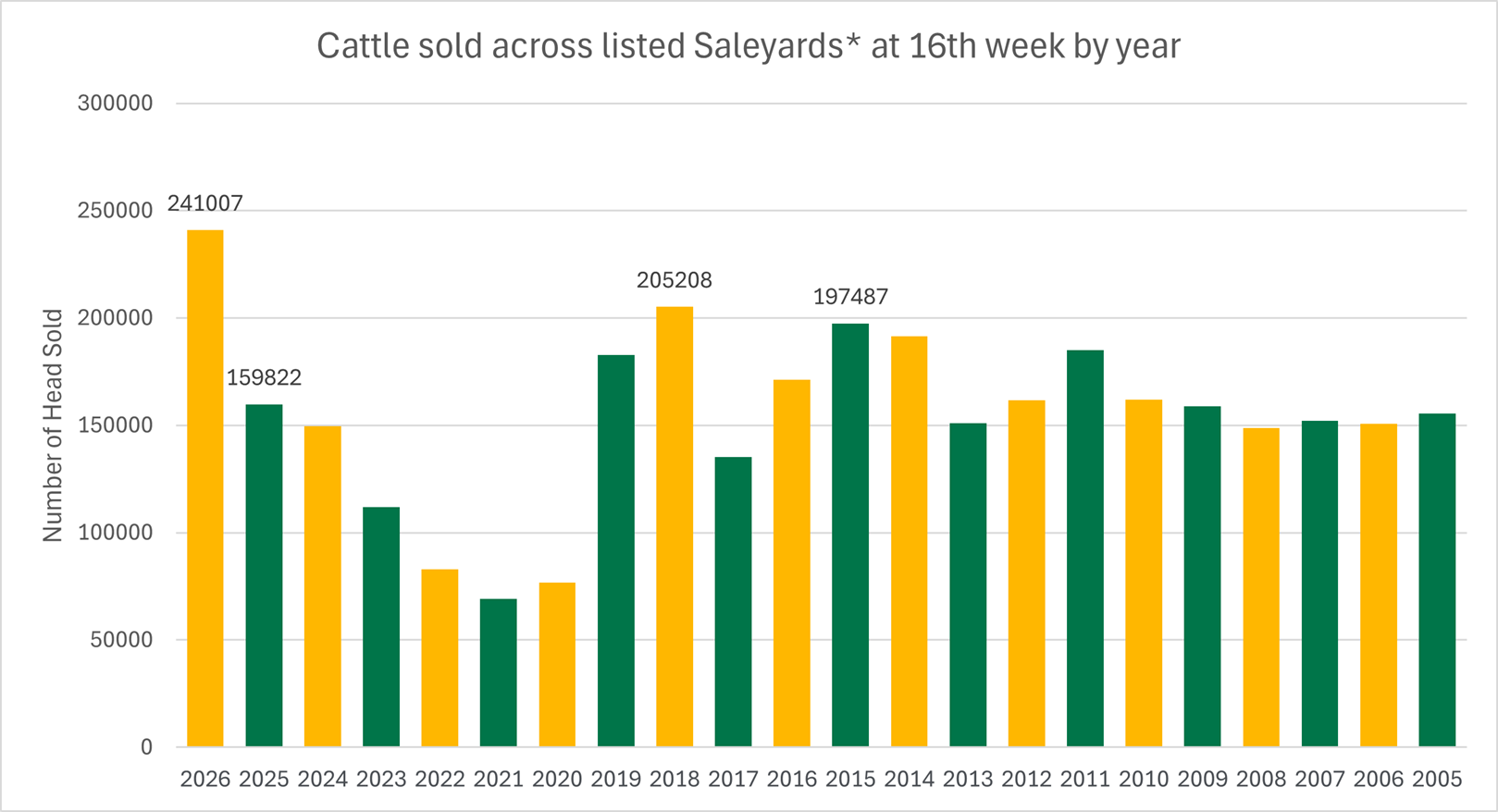
Saleyards included are Tamworth, Gunnedah, Inverell, Armidale, Scone and Dubbo.Source: NLRS
Attribute content to: Alex Fry, MLA Market Information Analyst.
Information is correct at time of writing on 16 April 2026.
MLA makes no representations as to the accuracy, completeness or currency of any information contained in this publication. Your use of, or reliance on, any content is entirely at your own risk and MLA accepts no liability for any losses or damages incurred by you as a result of that use or reliance. No part of this publication may be reproduced without the prior written consent of MLA. All use of MLA publications, reports and information is subject to MLA’s Market Report and Information Terms of Use.
Source:MLA

